
The Integrated Athlete Care Model: Why Rehab and Performance Must Live in the Same Environment
Why rehab and performance should live in the same environment. Learn how integrated athlete care improves return-to-play outcomes by aligning clinicians, coaches, and training systems.
STRENGTH AND CONDITIONINGRECOVERYINTEGRATION
Elite Performance Lab
2/21/20262 min read
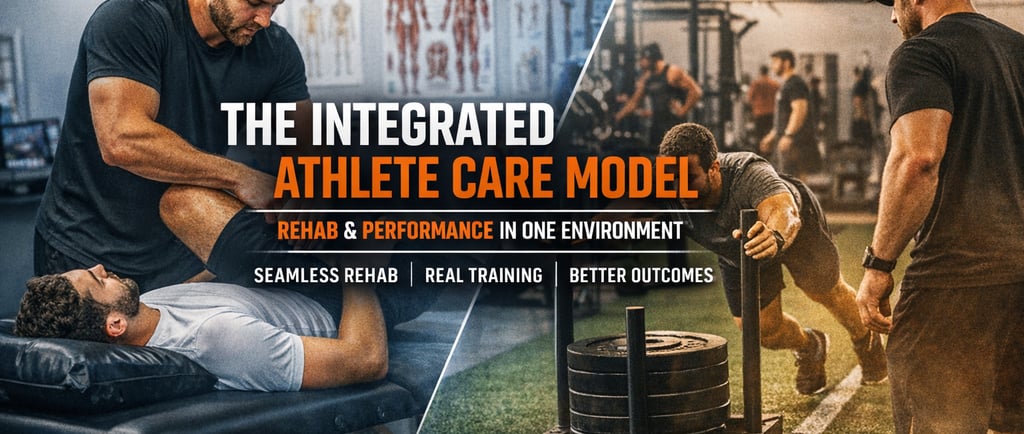
The Integrated Athlete Care Model: Why Rehab and Performance Must Live in the Same Environment
Modern athletes rarely fail in rehabilitation because of poor treatment. More often, they fail because of poor integration. Traditional models separate injury care from performance training, placing rehab in one setting and strength, conditioning, and sport preparation in another. While each environment may function well independently, the disconnect between them creates gaps in communication, context, and decision-making. Those gaps are where progress stalls and reinjury risk increases.
In most systems, rehabilitation focuses on resolving symptoms and restoring isolated physical qualities, while performance training emphasizes output, capacity, and sport expression. The problem arises when athletes are expected to transition abruptly from a clinical environment into full training without a shared framework guiding that progression. Clearance decisions are often based on clinic-based metrics rather than on how the athlete tolerates real workloads, movement variability, and competitive intensity. Coaches receive limited information, clinicians lose visibility once the athlete leaves the clinic, and athletes are left navigating the gray area between “rehab” and “performance.”
This is why the environment matters. Rehabilitation does not truly end when pain decreases or the range of motion improves, it ends when an athlete can tolerate the demands of their sport environment consistently and confidently. When rehab and performance exist in separate spaces, clinicians are forced to predict training demands rather than observe them, and coaches are asked to manage injury considerations without direct clinical input. Embedding care within a performance environment removes this guesswork. Progressions are no longer theoretical; they are continuously validated against the athlete’s actual training demands.
The integrated athlete care model aligns clinicians, coaches, and athletes under one shared system. Assessment, treatment, rehabilitation, and performance progression are not treated as separate phases but as overlapping processes that evolve together. Rather than pulling athletes out of training, care is layered into it. Clinicians guide load exposure, movement capacity, and return-to-play decisions alongside coaches, while performance staff gain real-time insight into tissue tolerance, recovery trends, and risk management. This creates continuity instead of handoffs, allowing decisions to be made collaboratively and proactively.
Operating within a shared environment raises the standard of care for everyone involved. Athletes return to sport with greater durability and fewer setbacks because progressions are built around real performance demands, not isolated clinic benchmarks. Coaches gain clarity and confidence in programming decisions, supported by clinical context rather than restrictions delivered after the fact. Facilities benefit from reduced downtime, improved athlete retention, and a system that prioritizes long-term development over short-term clearance.
The future of athlete care is not defined by more exercises or harder training blocks, but by better systems. At Elite Performance Lab, we embed clinical care directly into high-performance environments to eliminate the disconnect between rehabilitation and training. By unifying assessment, treatment, and performance under one roof, we ensure that return-to-play decisions translate directly to return-to-performance outcomes. Rehab should not prepare athletes for the clinic, it should prepare them for sport.
Get in touch
Contact
Reach out for appointments and inquiries
© 2025 Elite Performance Lab Inc. All rights reserved.